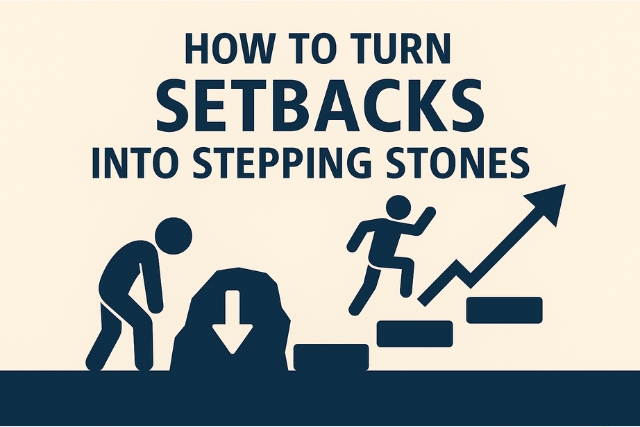
Setbacks are an inevitable part of life. Whether it’s a failed project, a missed opportunity, or a personal disappointment, challenges test our patience, resilience, and belief in ourselves. But here’s the truth: every setback carries the seed of growth—if you choose to see it that way. The most successful people in history didn’t rise despite failure; they rose because of it. The secret lies in how you respond.
Understanding Setbacks as Opportunities
A setback isn’t the end of your journey; it’s a detour that redirects you toward something greater. Psychologists call this concept “post-traumatic growth”—the ability to grow stronger after adversity. When things don’t go as planned, your brain is forced to adapt, rethink, and evolve. This process helps you build resilience, creativity, and problem-solving skills—all essential traits for long-term success.
Instead of asking “Why did this happen to me?”, shift your mindset to “What is this teaching me?” That single question transforms frustration into wisdom.
Step 1: Accept and Reflect
The first step in turning setbacks into stepping stones is acceptance. Denying or avoiding your failure only prolongs the pain. Take a deep breath and acknowledge what went wrong—without judgment. Reflection allows you to separate emotion from logic so you can learn objectively.
Ask yourself:
- What did I learn from this experience?
- What could I do differently next time?
- How can this situation make me stronger or smarter?
This reflective thinking turns pain into power.
Step 2: Reframe Your Mindset
How you interpret failure determines your growth. People with a growth mindset—a term popularized by psychologist Carol Dweck—see challenges as opportunities to improve rather than signs of inadequacy. When you reframe setbacks as stepping stones, you stop fearing them and start leveraging them.
Try this reframe:
- Instead of “I failed,” say “I discovered what doesn’t work.”
- Instead of “I’m not good enough,” say “I’m still learning and improving.”
- Instead of “It’s over,” say “This is a new beginning.”
Step 3: Take Strategic Action
Learning from a setback means adjusting your strategy, not abandoning your goal. Use what you’ve learned to move forward smarter. If you lost a client, improve your pitch. If your plan didn’t work, analyze what needs tweaking. Every setback gives you data—and that data is your roadmap to success.
Success is rarely a straight line; it’s a series of failures that sharpen your focus. Thomas Edison famously said, “I haven’t failed—I’ve just found 10,000 ways that won’t work.” That’s the essence of resilience.
Step 4: Build Resilience Through Habits
Resilience isn’t a trait you’re born with—it’s a muscle you build. Habits like journaling, meditation, physical exercise, and gratitude practice help you recover faster from adversity. The more you strengthen your mental health, the better equipped you are to handle future challenges.
Step 5: Celebrate Progress, Not Perfection
Perfectionism often makes setbacks feel worse than they are. Remember, success is a journey of progress. Celebrate small wins—the lessons learned, the courage to try again, the determination to rise. Every step forward, no matter how small, is proof of your growth.
Final Thoughts
Setbacks don’t define you—your response does. When you embrace challenges as part of your evolution, you transform pain into purpose and mistakes into momentum. The next time you stumble, remind yourself: this isn’t a roadblock—it’s a stepping stone.
Because success isn’t about avoiding failure; it’s about mastering the art of rising stronger every time you fall. 🌱