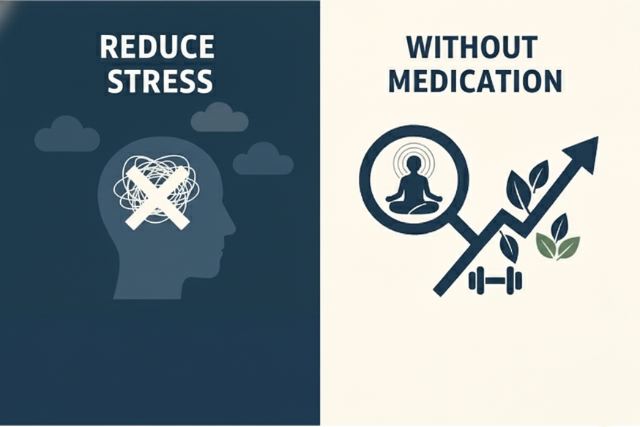
In today’s fast-paced world, stress feels almost impossible to avoid. From work deadlines to digital overload, our minds rarely get a break.
But here’s the good news — you don’t need pills or expensive therapy sessions to calm your body and mind.
Science shows that simple daily habits can lower cortisol (the stress hormone), improve focus, and restore your emotional balance naturally.
Let’s explore 10 proven ways to reduce stress without medication — backed by psychology, neuroscience, and mindfulness research.
🧘♀️ 1. Practice Deep, Intentional Breathing
When stress hits, your breathing becomes shallow — signaling your brain that danger is near.
Deep breathing reverses that response.
Try this:
The 4-7-8 technique — inhale for 4 seconds, hold for 7, exhale for 8.
Repeat 4 times.
This activates the parasympathetic nervous system, which calms your body instantly.
📖 Research Insight:
Harvard Health studies show deep breathing reduces heart rate and anxiety levels within minutes.
🌳 2. Spend Time in Nature
Even a short walk outdoors can lower cortisol and improve mood.
Nature helps reset your nervous system by reducing sensory overload and reconnecting you to calm, grounded energy.
Try this:
Take a 15-minute “mindful walk.” Notice the sounds, textures, and colors around you.
No phone, no rush.
📖 Research Insight:
A Stanford University study found that walking in nature decreases rumination — the repetitive negative thinking linked to depression.
📔 3. Journal Your Thoughts Daily
Journaling helps you process emotions, release mental clutter, and find clarity.
Try this:
Each night, write down:
- What stressed me today?
- How did I handle it?
- What can I do differently tomorrow?
📖 Research Insight:
Expressive writing has been shown to improve mental well-being and reduce stress-related symptoms.
💤 4. Prioritize Sleep Quality
Sleep is your body’s natural stress reset button.
Yet many people sacrifice it first when overwhelmed.
Try this:
Set a digital curfew — no screens 1 hour before bed.
Create a relaxing ritual with dim lights and deep breathing.
📖 Research Insight:
Sleep deprivation increases cortisol and impairs emotional regulation, making you more reactive to stress.
🧠 5. Practice Mindfulness Meditation
Mindfulness teaches your brain to focus on the present moment — not the worries of the past or future.
Try this:
Spend 10 minutes observing your breath.
If your mind wanders, gently bring it back — no judgment.
📖 Research Insight:
Neuroscientists have found that regular meditation thickens the prefrontal cortex — the area responsible for emotional control.
🤝 6. Connect With Supportive People
Stress grows in isolation. Talking with someone you trust can help you feel seen and supported.
Try this:
Schedule a “connection call” — 10 minutes to chat openly with a friend or family member.
📖 Research Insight:
Human connection increases oxytocin (the bonding hormone), which reduces the effects of cortisol.
🕯️ 7. Practice Gratitude
Gratitude flips your brain’s focus from what’s missing to what’s working.
Try this:
Write down 3 things you’re grateful for every morning — even small things like “a warm cup of tea” or “my body’s strength.”
📖 Research Insight:
Studies from UC Berkeley show gratitude practices improve happiness and reduce stress levels over time.
🧍 8. Move Your Body (Even for 10 Minutes)
Exercise releases endorphins — natural chemicals that combat stress and elevate mood.
Try this:
Take a brisk 10-minute walk, stretch, or dance to your favorite song.
The goal isn’t intensity — it’s consistency.
📖 Research Insight:
Even short bouts of physical activity significantly reduce anxiety and depression symptoms.
🎶 9. Listen to Relaxing Music
Music can shift your brainwaves and regulate emotions.
Try this:
Play soft instrumental or nature sounds while working, meditating, or resting.
Your nervous system will naturally slow down.
📖 Research Insight:
Studies show that calm music (60–80 bpm) can lower blood pressure and heart rate.
☕ 10. Limit Caffeine and Sugar
High caffeine or sugar spikes your energy — and crashes it soon after, worsening stress and irritability.
Try this:
Replace your third cup of coffee with herbal tea or lemon water.
Notice how your body feels calmer throughout the day.
📖 Research Insight:
Caffeine overstimulates the adrenal glands, keeping your body in a state of “fight or flight.”
🌈 Final Thoughts
Stress is a signal — not a sentence.
Your body is simply asking for balance.
By practicing these 10 science-backed techniques, you can retrain your mind and body to stay calm, even in chaos.
Remember, the goal isn’t to eliminate stress completely — it’s to learn how to navigate it mindfully and peacefully.
Take a deep breath. You’ve got this. 🌿