🌅 Introduction: The Science Behind Gratitude and the Brain
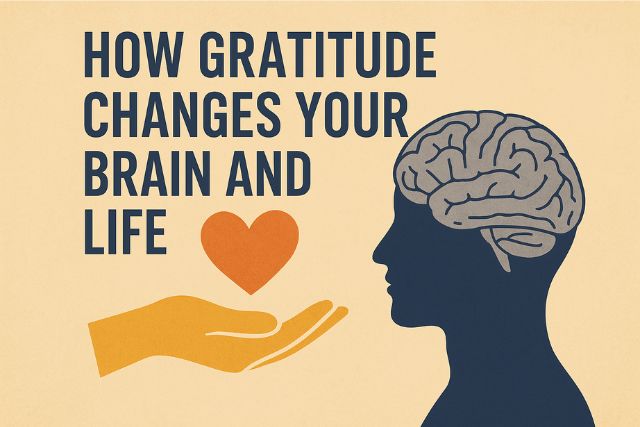
Ever wondered how gratitude changes your brain and life? Gratitude isn’t just a polite “thank you” — it’s a scientifically proven mindset that can rewire your brain, improve mental health, and even enhance relationships.
In recent years, neuroscientists and psychologists have uncovered that practicing gratitude actually alters brain chemistry, strengthening neural pathways related to positivity and well-being.
In this article, we’ll explore what happens inside your brain when you feel thankful, how this shift transforms your daily life, and simple practices you can start today to unlock gratitude’s power.
🧠 1. The Neuroscience of Gratitude
Gratitude works like a natural antidepressant. When you express genuine appreciation, your brain releases dopamine and serotonin — the two “feel-good” neurotransmitters that elevate mood and motivation.
Studies using fMRI scans (functional Magnetic Resonance Imaging) show that gratitude activates the ventromedial prefrontal cortex, the region responsible for managing emotions, empathy, and decision-making.
Over time, this activation builds stronger neural connections, creating a “gratitude circuit” — meaning your brain learns to look for the good in every situation automatically.
👉 According to a study published in Frontiers in Psychology, individuals who practiced gratitude journaling for three weeks showed measurable changes in brain activity linked to long-term happiness.
🌈 2. How Gratitude Rewires Your Brain for Positivity
Think of your brain as a muscle — whatever you focus on, grows stronger.
If you constantly dwell on stress and negativity, your brain reinforces those patterns. But when you consistently focus on gratitude, your reticular activating system (RAS) — the brain’s filter — starts seeking more reasons to be thankful.
That’s how gratitude rewires your brain:
- It trains your mind to spot positivity automatically.
- It weakens habitual negative thought loops.
- It fosters resilience by helping you reframe challenges.
Over time, gratitude literally changes the structure and chemistry of your brain, helping you respond to stress with calmness and clarity.
💖 3. Emotional Benefits: Gratitude and Happiness Go Hand-in-Hand
Gratitude doesn’t just feel good — it does good. When you express appreciation regularly, you:
- Experience fewer depressive symptoms
- Sleep better and longer
- Build stronger social bonds
- Feel more optimistic about the future
A 2015 study by the University of California found that people who kept gratitude journals reported 25% higher life satisfaction after just 10 weeks compared to those who didn’t.
In essence, gratitude is a natural happiness amplifier — it turns ordinary moments into meaningful ones.
🧩 4. The Connection Between Gratitude and Mental Health
Practicing gratitude activates the parasympathetic nervous system, which helps your body relax and recover from stress.
This reduces cortisol (the stress hormone), promoting emotional balance and inner peace. Gratitude also counteracts anxiety and overthinking by anchoring you in the present moment, much like mindfulness meditation.
🧘♀️ Try this:
When you feel overwhelmed, pause and name three things you’re grateful for right now — even small ones like your morning coffee or a supportive friend.
Within seconds, your mood shifts and your brain calms down.
🌍 5. Gratitude’s Ripple Effect on Relationships and Career
Gratitude doesn’t just change you — it changes how others respond to you.
When you express appreciation at work, in friendships, or at home, it strengthens trust and cooperation. People naturally gravitate toward those who make them feel valued.
This creates a positive feedback loop:
- You express gratitude → others feel good → they act kindly → you feel grateful again.
In leadership and teamwork, gratitude enhances productivity and engagement.
That’s why many successful leaders, including CEOs and entrepreneurs, make gratitude a daily leadership habit.
(You can explore more about positive leadership habits in our post: “5 Morning Rituals That Set the Tone for a Productive Day”).
🧬 6. Gratitude and Physical Health: Your Body Feels It Too
It’s not just your mind that benefits — your body does too.
Research from Harvard Medical School shows that gratitude improves immune response, reduces inflammation, and can even lower blood pressure.
Here’s how gratitude boosts your physical health:
- Better Sleep: You fall asleep faster with fewer negative thoughts.
- Reduced Pain: People who practice gratitude report lower pain perception.
- Heart Health: Gratitude promotes calmness, improving heart rate variability.
The simple act of appreciating your body — no matter its flaws — can transform how you treat yourself, leading to healthier habits and self-care.
📓 7. How to Practice Gratitude Daily (Simple but Powerful)
You don’t need grand gestures to cultivate gratitude. Start small and stay consistent.
🔸 1. Keep a Gratitude Journal
Every morning or night, write down 3 things you’re grateful for.
Be specific — instead of “I’m thankful for my family,” write “I’m thankful for the laughter we shared over dinner tonight.”
🔸 2. Gratitude Letters
Write a short message to someone who’s made a difference in your life — even if you never send it.
According to Greater Good Science Center (UC Berkeley), writing gratitude letters boosts happiness for weeks.
🔸 3. Gratitude Meditation
During meditation, focus on moments of appreciation.
Visualize them vividly — feel the warmth and joy as if it’s happening again.
🔸 4. Express Thanks Out Loud
Make it a habit to say “thank you” genuinely — to coworkers, family, or even yourself for small wins.
🔸 5. Gratitude Jar
Write daily notes of appreciation on slips of paper.
At the end of each month, read them back to see how far you’ve come.
(You can check our detailed post: “The Psychology of Positive Thinking: Rewiring Your Brain for Success”) for more habit-building ideas.
🧭 8. Gratitude vs. Toxic Positivity
While gratitude is powerful, it’s not about ignoring pain or pretending everything is perfect.
Toxic positivity denies real emotions, while gratitude acknowledges reality but chooses to focus on what’s still good.
Healthy gratitude sounds like:
“This is tough, but I’m grateful for the lessons it’s teaching me.”
That balance helps you stay grounded and authentic — not dismissive of your feelings.
💡 9. How Long Does It Take to Rewire Your Brain?
Neuroplasticity — your brain’s ability to form new neural pathways — takes time.
Research suggests consistent gratitude practice for 21–66 days can lead to lasting changes in mood and perspective.
It’s like planting seeds. At first, you may not see results. But as you water them daily with gratitude, you’ll wake up one day realizing you’ve become naturally happier and calmer.
🌠 10. Real-Life Examples: Gratitude in Action
- Oprah Winfrey has kept a gratitude journal for decades, crediting it as her most transformative practice.
- Harvard researchers found that patients recovering from heart attacks who practiced gratitude healed faster and had better outcomes.
- Even U.S. military veterans struggling with PTSD showed significant improvement after gratitude-based therapy sessions.
These examples prove one thing — gratitude is more than a feel-good habit; it’s mental fitness for the soul.
🔗 11. Internal and External Resources
Internal Links:
External Links:
- Harvard Health Publishing: The Power of Gratitude
- UC Berkeley Greater Good Science Center – Gratitude Research
🌻 Conclusion: Gratitude as a Daily Life Skill
Gratitude is more than just saying “thanks.”
It’s a mindset that reprograms your brain, strengthens your emotional health, and turns everyday moments into sources of joy.
The best part? It’s free, simple, and available to everyone.
When you start focusing on what’s right — instead of what’s wrong — you’ll notice that life begins to unfold in more beautiful, meaningful ways.
So today, take one small step:
👉 Write down three things you’re grateful for.
Tomorrow, repeat it.
Soon, you’ll discover the incredible truth — gratitude doesn’t just change your brain, it changes your life.