We’ve all been there — that moment when your mind feels like your biggest enemy. One small setback, and suddenly you’re spiraling into self-doubt, “what ifs,” and “I’m not good enough.”
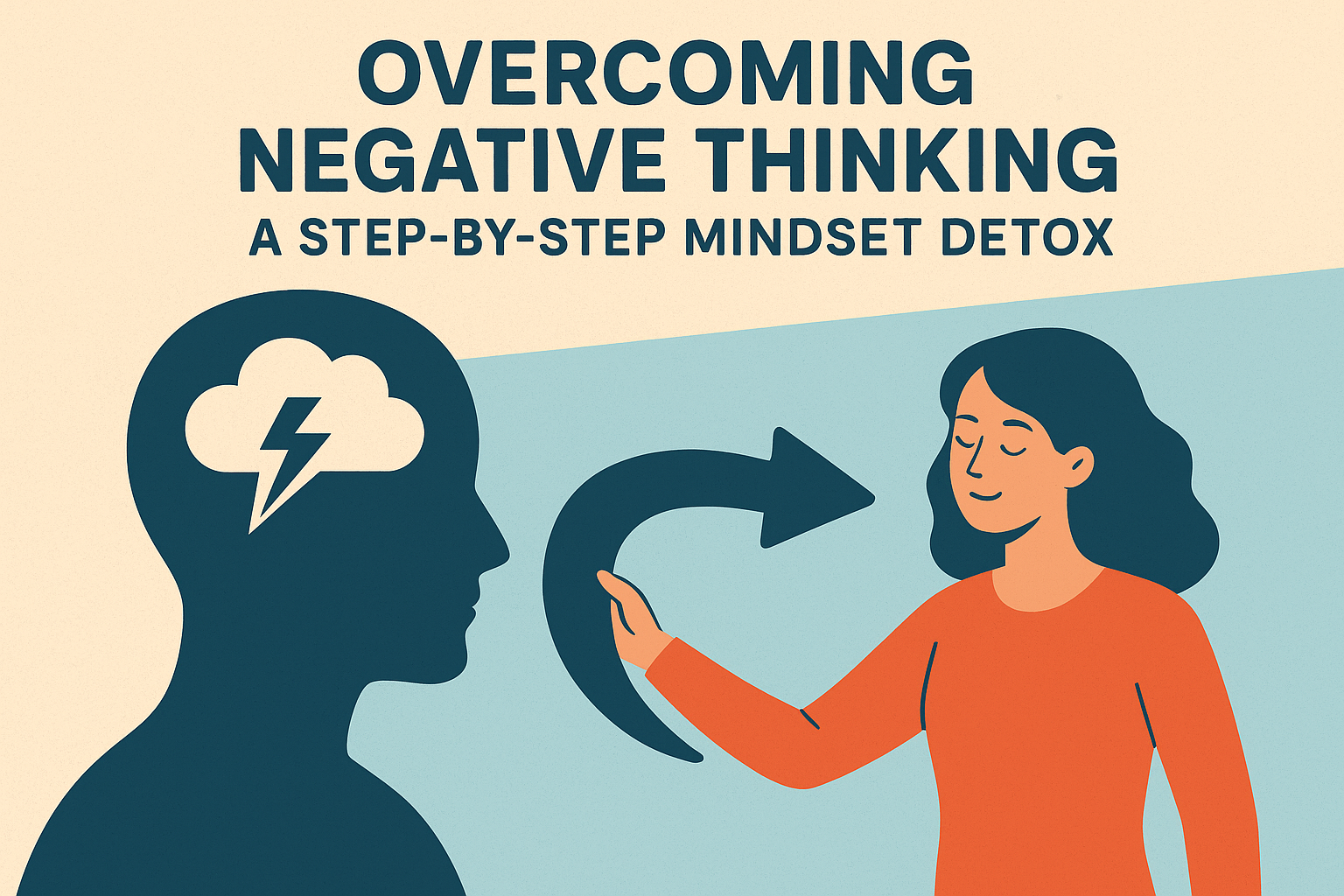
But here’s the truth: negative thinking isn’t who you are — it’s a habit you’ve learned.
And like any habit, it can be rewired and replaced.
In this article, we’ll take a step-by-step look at how to overcome negative thinking through a practical mindset detox. Whether you’re a student trying to build confidence, a professional chasing big goals, or an entrepreneur battling self-doubt — these strategies will help you shift from mental chaos to calm clarity.
Step 1: Recognize the Thought Patterns Holding You Back
The first step in any transformation is awareness.
You can’t fix what you don’t see.
Start by noticing your automatic thoughts — those mental reactions that pop up before you even realize it:
- “I’ll probably fail.”
- “They’re better than me.”
- “Why do I even try?”
👉 Tip: Keep a small “thought journal” for one week. Each time you notice a negative thought, write it down. By the end of the week, you’ll start seeing clear patterns — your personal “mental playlist.”
🧩 Internal Link: Read our article on The Psychology of Positive Thinking: Rewiring Your Brain for Success to understand how your thoughts shape your reality.
Step 2: Challenge the Thought — Don’t Believe Everything You Think
Here’s something life-changing: a thought is not a fact.
Your mind often exaggerates fears to keep you “safe.” But in doing so, it limits your growth.
Ask yourself:
- Is this thought absolutely true?
- What evidence do I have for or against it?
- What would I tell a friend who thought this way?
This simple mental dialogue starts to break the power of negative thinking. It’s like shining light on shadows — they shrink the moment you notice them.
💡 External Resource: Cognitive Behavioral Therapy (CBT) techniques can help you learn to reframe thoughts effectively.
Step 3: Reframe with Empowering Alternatives
Once you’ve challenged a negative thought, replace it with something realistic and constructive.
Example:
❌ “I always fail.”
✅ “Sometimes things don’t work out — but I’m improving every time.”
This shift from absolute to adaptive thinking rewires your brain toward resilience.
Over time, you train your mind to see opportunities instead of obstacles.
🔁 Mini Habit: Every night, write one negative thought you caught during the day — and reframe it with an empowering version.
Step 4: Detox Your Environment
Your mental environment is shaped not just by thoughts, but also by the people, media, and habits you surround yourself with.
Ask yourself:
- Who drains my energy? Who uplifts it?
- What content do I consume daily — does it feed growth or fear?
- Are my daily habits aligned with a positive mindset?
Start making small swaps:
📱 Replace doomscrolling with reading inspiring blogs like Tiny Buddha.
🎧 Replace complaint sessions with gratitude check-ins.
🎬 Replace negative news binges with motivational podcasts.
Every small detox adds up — you are literally curating your mental space.
Step 5: Practice Gratitude as a Mental Reset
Gratitude is the antidote to negativity.
When you focus on what’s good, your brain starts scanning for more of it.
Try this simple 3-minute gratitude ritual each night:
- Write down 3 things you’re thankful for today.
- Reflect on why each of them mattered.
- Feel that sense of appreciation — deeply.
🌱 Within 30 days, you’ll start noticing a mental shift: less comparison, more contentment.
Step 6: Build a “Positivity Anchor” Routine
Discipline your mind like you’d train a muscle.
Here’s a simple morning routine you can follow to anchor yourself in positivity:
- 2 minutes of deep breathing — calm your nervous system.
- Affirmations — say them out loud (“I’m capable, I’m focused, I’m growing”).
- Visualization — see yourself succeeding in your day’s key task.
- Movement — 5 pushups, stretching, or a short walk to activate energy.
These anchors retrain your subconscious mind to default to positivity.
🧠 Internal Link: You can also explore our guide on How to Set Effective SMART Goals and Achieve Them to stay focused and aligned.
Step 7: Use Affirmations (That Actually Work)
Affirmations only work if they feel believable.
Don’t force “I’m perfect” — instead try:
- “I’m improving every day.”
- “I’m learning how to handle challenges.”
- “I trust myself to figure things out.”
Over time, these realistic affirmations reshape your self-image.
🧩 Tip: Record them in your voice and listen while commuting or exercising.
Step 8: Surround Yourself with Growth-Oriented People
Energy is contagious — so protect yours.
Join communities that discuss growth, mindset, and motivation. Participate in discussions, follow uplifting creators, and engage with others who are building something meaningful.
🌍 External Resource: The subreddit r/selfimprovement is a great place to start learning and sharing insights.
Step 9: Turn Setbacks Into Lessons
Even the most positive people face failures — they just interpret them differently.
Instead of “I failed,” they say, “I learned.”
👉 Every setback is data.
Review what went wrong, adjust your strategy, and move forward stronger.
Failure isn’t opposite to success — it’s the path to it.
Step 10: Commit to a Lifetime of Mental Fitness
Think of your mind like a garden.
If you don’t nurture it, weeds (negative thoughts) grow back.
So keep tending to it — read uplifting books, meditate, journal, and keep learning.
🧠 Suggested Reading:
- Atomic Habits by James Clear
- The Subtle Art of Not Giving a Fck* by Mark Manson
- The Power of Now by Eckhart Tolle
Conclusion
Overcoming negative thinking isn’t a one-time fix — it’s a lifelong skill.
Every thought you challenge, every moment you reframe, every bit of gratitude you practice — it all compounds into a stronger, calmer, more confident version of you.
So start today.
Choose one small step from this article and act on it.
Because every positive thought is a seed — and your future self will thank you for planting it today. 🌿