🧠 Introduction: Why Your To-Do List Is Failing You
Let’s be honest — your to-do list is probably too long.
Most of us write down everything we need to do — work, errands, emails, personal goals — and then feel overwhelmed by the sheer volume of tasks. The result? We stay busy, not productive.
That’s where the Eisenhower Matrix comes in. It’s a simple but powerful framework that helps you focus on what truly matters — and let go of the rest.
(Image suggestion: A minimalist digital illustration of a person balancing tasks in four quadrants labeled “Urgent/Important”, “Not Urgent/Important”, etc.)
🚀 What Is the Eisenhower Matrix?
The Eisenhower Matrix, also known as the Urgent-Important Matrix, was developed by Dwight D. Eisenhower, the 34th President of the United States. He famously said:
“What is important is seldom urgent, and what is urgent is seldom important.”
This concept was later popularized by productivity expert Stephen Covey in The 7 Habits of Highly Effective People.
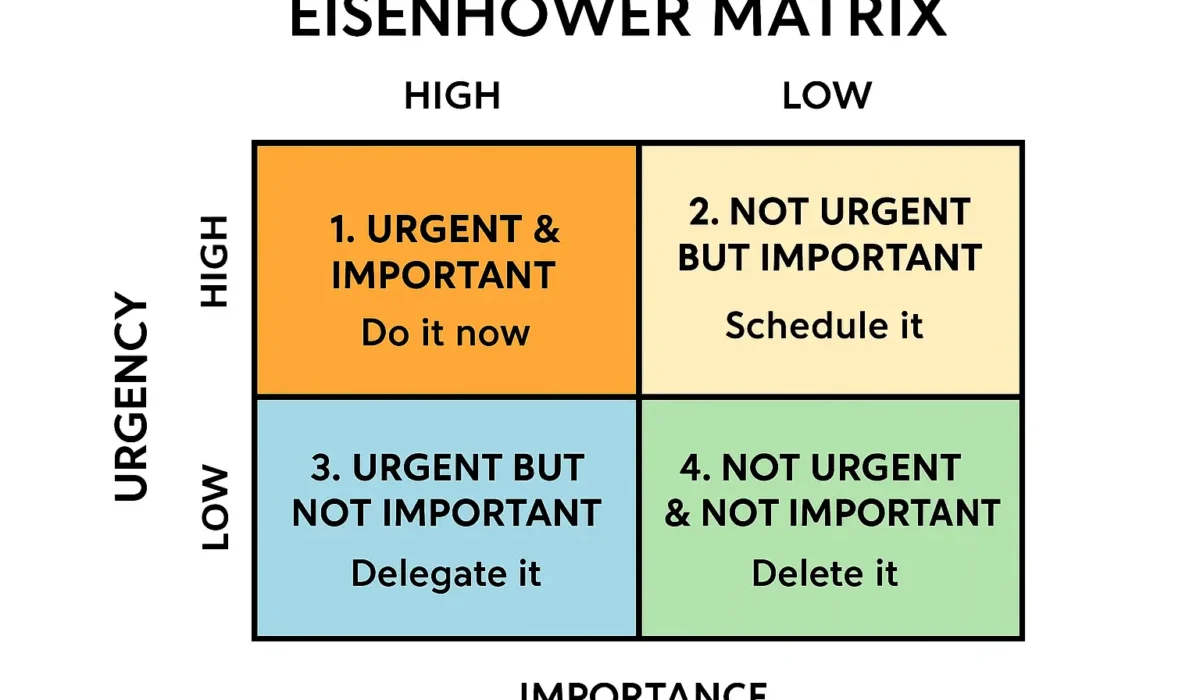
The matrix divides your tasks into four quadrants:
| Quadrant | Urgency | Importance | Action |
|---|---|---|---|
| 1. Urgent & Important | High | High | Do it now |
| 2. Not Urgent but Important | Low | High | Schedule it |
| 3. Urgent but Not Important | High | Low | Delegate it |
| 4. Not Urgent & Not Important | Low | Low | Delete it |
(Image suggestion: Clean infographic showing the four quadrants of the Eisenhower Matrix.)
🧩 Quadrant 1: Urgent and Important — Do It Now
These are the crisis-mode tasks — things that have immediate deadlines and serious consequences if ignored.
✅ Examples:
- Project due tomorrow
- Medical emergency
- Client issue that needs immediate resolution
📘 Tip: Don’t let your life live entirely in Quadrant 1. Too many emergencies mean you’re reacting instead of planning.
Internal Link:
👉 Read our post on How to Stay Calm Under Pressure
🧘 Quadrant 2: Not Urgent but Important — Schedule It
This is where growth and long-term success live.
Tasks here contribute to your goals, relationships, and self-improvement — but they don’t scream for your attention.
✅ Examples:
- Exercise and wellness routines
- Learning new skills
- Strategic planning
- Relationship building
📘 Tip: Spend more time here. It’s where high performers focus.
External Link:
👉 Learn more about time-blocking techniques on Todoist Blog
🧾 Quadrant 3: Urgent but Not Important — Delegate It
These are the tasks that feel urgent but don’t align with your goals. They often come from other people’s priorities.
✅ Examples:
- Unnecessary meetings
- Some phone calls and emails
- Administrative requests
📘 Tip: Use delegation tools like Trello, Notion, or ClickUp to assign tasks without losing track.
(Image suggestion: Flat-style illustration showing someone delegating tasks to others using digital tools.)
🗑 Quadrant 4: Not Urgent and Not Important — Delete It
Here’s where time-wasters hide. These are the distractions that drain your energy but don’t add any value to your life.
✅ Examples:
- Endless social media scrolling
- Watching random YouTube videos
- Gossip or unproductive conversations
📘 Tip: Don’t eliminate rest — eliminate mindless activity. Learn to recharge intentionally.
Internal Link:
👉 Explore our post on Digital Detox: Reclaim Your Focus in a Noisy World
- List all your tasks.
Write down everything you plan to do today or this week. - Assign each task to a quadrant.
Ask yourself: Is this urgent? Is this important? - Act accordingly.
- Q1 → Do it immediately
- Q2 → Schedule it
- Q3 → Delegate
- Q4 → Delete
- Review weekly.
Reflect on how much time you spent in each quadrant. The goal is to minimize Q3 and Q4.
(Image suggestion: A digital planner or task board divided into four colored quadrants.)
💡 Example: Eisenhower Matrix in Action
Let’s say you’re a student working on a big exam while managing part-time work.
| Task | Quadrant | Action |
|---|---|---|
| Study for exam | Q2 | Schedule daily study sessions |
| Urgent work deadline | Q1 | Do immediately |
| Friend’s casual chat | Q4 | Delay or skip |
| Answering routine emails | Q3 | Delegate or batch later |
Notice how organizing this way gives clarity and calm instead of chaos.
🔄 Combine It with Other Productivity Systems
The Eisenhower Matrix becomes even more powerful when you pair it with systems like:
- Pomodoro Technique – Focus in short bursts with breaks.
- Habit Stacking – Build discipline through small wins.
- Time Blocking – Reserve slots for deep work.
Internal Link:
👉 Check out The Power of Consistency: Why Small Habits Create Big Change
✨ Conclusion: Focus on What Truly Matters
The Eisenhower Matrix isn’t just a productivity tool — it’s a mindset.
It helps you move from reacting to intentionally designing your day. When you stop chasing every urgent thing and start prioritizing what’s truly important, your focus sharpens, your stress decreases, and your progress accelerates.
“The key is not to prioritize what’s on your schedule, but to schedule your priorities.” — Stephen Covey
Take 10 minutes today to draw your Eisenhower Matrix — and start shaping a life that’s not just busy, but balanced and meaningful.