Table of Contents
- What Are SMART Goals & Why They Matter
- Deep Dive: Each Element of SMART
- How to Write SMART Goals: Step-by-Step
- Tips to Stay On Track & Overcome Challenges
- Examples of SMART Goals (for Professionals, Students, Entrepreneurs)
- Common Mistakes & How to Avoid Them
- Tools and Apps to Help You Achieve SMART Goals
- FAQ: Frequently Asked Questions
- Final Takeaways
1. What Are SMART Goals & Why They Matter
Let’s kick things off in a way that hits home. You’ve probably heard goals like “I want to get in shape” or “I want a promotion.” Great intentions, but vague. When a goal feels fuzzy or big, figuring out where to start, how to measure progress, and when you’re done becomes a guessing game. That’s where SMART goals come in.
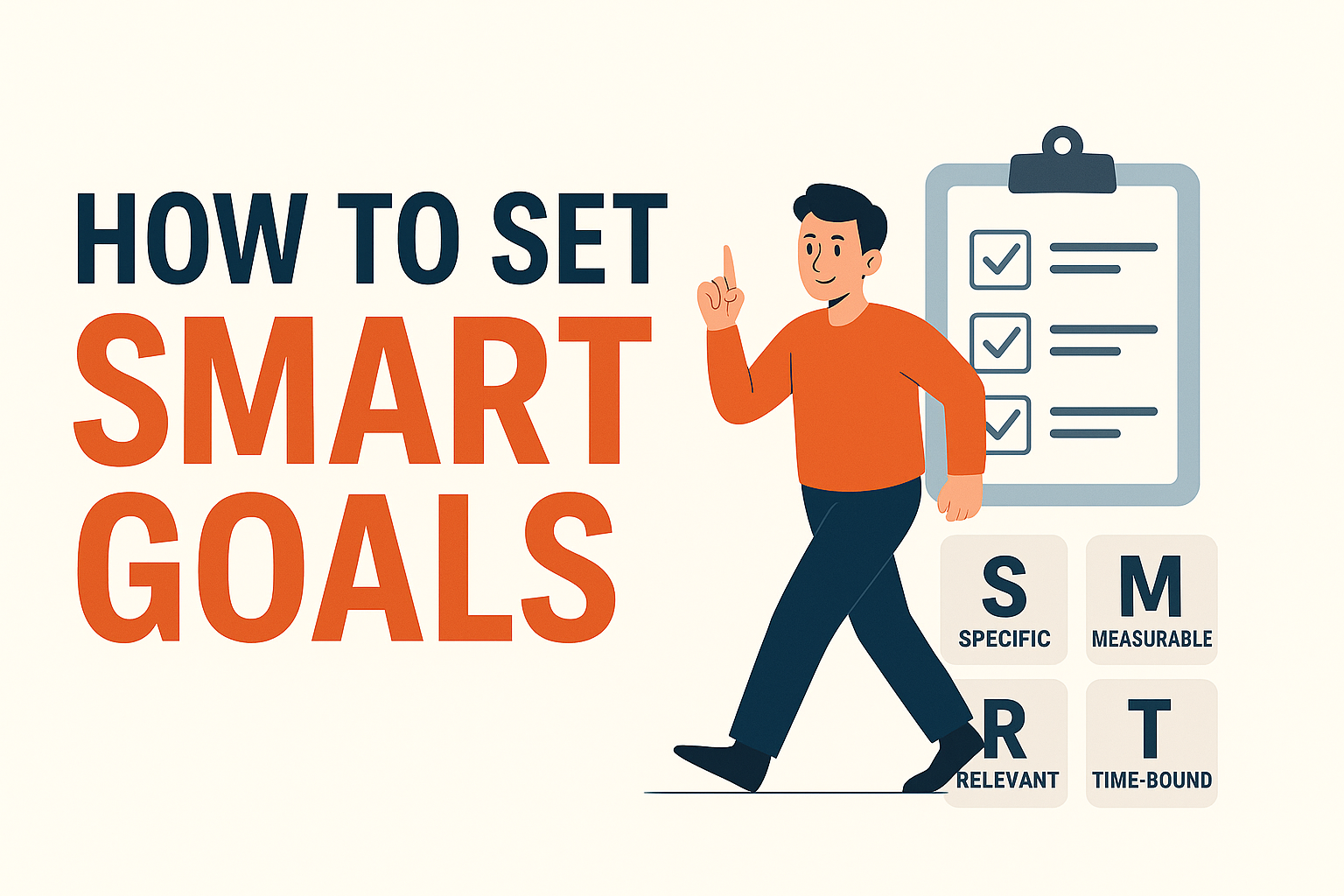
SMART is an acronym: Specific, Measurable, Achievable, Relevant, Time-bound. It’s a proven framework that turns vague dreams into actionable plans.
Why SMART Goals Work
- They force clarity. When you define what you want, why, and how, your brain focuses.
- They give you measurable checkpoints, which are crucial for motivation. Tracking small wins = consistent growth.
- They help you avoid over-committing, burnout, or goals that drift away because they’re irrelevant.
- They make it much easier to plan backward (i.e. figure out what you must do now, next week, etc.).
2. Deep Dive: Each Element of SMART
Let’s unpack each letter in SMART with what it truly means (not just textbook definitions) plus examples.
| Element | What It Really Means | Powerful Questions to Ask Yourself | Example |
|---|---|---|---|
| Specific | Not vague; clearly defines who, what, why, where, and how. | “What exactly do I want?” “Why is this important?” “What steps are included?” | “I want to improve my public speaking by delivering at least 3 presentations at work this year.” |
| Measurable | You can track progress; metrics or criteria defined. | “How will I know I’m making progress?” “What does success look like?” | “Increase my presentations number from 0 to 3; get feedback from at least 2 people each time.” |
| Achievable | Realistic given your resources (time, skills, budget), but still challenging. | “Do I have the skills and resources?” “What might I need to learn?” | “I’ll join a Toastmasters club or take a public speaking course to build confidence.” |
| Relevant | Aligned with your larger goals, values, or mission. Something that actually matters. | “Does this goal matter to me long-term?” “Does it align with what I’m doing in other areas?” | “Since I aim to lead my team next year, improving speaking skills will help.” |
| Time-bound | There’s a deadline or schedule, with interim milestones. | “By when will I achieve this goal?” “What are the milestones?” “What is the finish line?” | “Deliver 3 presentations by December 31st; aim for one each quarter.” |
3. How to Write SMART Goals: Step-by-Step
Here’s a hands-on process you can follow — literally write it out. Great for students, professionals, entrepreneurs alike.
- Brainstorm your big vision.
What do you ultimately want? Career advancement, improved health, new skill, business growth. Let your mind roam. - Pick one or two focus areas.
You don’t have bandwidth to chase everything. Choose what matters most now. - Use the SMART components to craft your goal. Fill in the table above (Specific, Measurable, etc.).
- Break your goal into smaller tasks or milestones.
For each SMART goal, create steps. E.g., for “3 presentations by December”, steps might be:- Research topics
- Create slide template
- Rehearse with peer
- Deliver first one by April etc.
- Set a timeline.
Schedule tasks on calendar, set check-ins weekly or monthly to track. - Identify potential obstacles and plan how to navigate them.
If time is limited, make small slots. If skill lacking, get coaching, etc. - Visualize success & write down the goal.
Studies and motivational psychology show that written goals + visualization increase follow-through. (You’re more likely to remember it, take action.) - Share your goal & get accountability.
Tell a friend, mentor, or use online groups. Accountability boosts consistency.
4. Tips to Stay On Track & Overcome Challenges
Even the best-crafted goals don’t execute themselves. Here’s how to walk the path:
- Review regularly. Set weekly or bi-weekly reviews. What’s working? What isn’t?
- Adjust when needed. Sometimes “Achievable” needs tweaking (maybe resources changed, timeline needs adjusting).
- Celebrate small wins. Each time you hit a milestone, reward yourself. Keeps motivation high.
- Stay flexible. Life happens. Be open to shifting timelines, methods, or intensity without abandoning the goal.
- Embrace discomfort. Growth often comes from pushing just outside comfort zone.
- Use visualization & affirmations. Picture yourself achieving the goal, feel the feelings. Helps in staying emotionally engaged.
- Stay accountable: peer, coach, or partner. Reporting your progress publicly or to someone helps.
5. Examples of SMART Goals (for Your Life)
Here are sample goals tailored to your audience:
| Role | Goal Example |
|---|---|
| Professional (Mid-level employee) | Increase my role to Team Lead by securing leadership training and completing 2 leadership projects by December 31st, 2025. |
| Entrepreneur | Grow revenue from $100K to $150K by end of Q4 2025 by adding two new product lines and improving customer retention by 20%. |
| Student | Raise my GPA from 3.2 to 3.8 over the next semester by studying 90 minutes daily, attending weekly study groups, and reviewing feedback after every test. |
Also useful: examples for personal development (learn a language, read more), wellness (sleep goals, fitness), etc.
6. Common Mistakes & How to Avoid Them
Even when you know the framework, many get tripped up. Here are pitfalls and remedies:
| Mistake | Fix / Avoidance |
|---|---|
| Goals too vague (e.g., “I want to get better”) | Use “Specific” language — add numbers, specifics. |
| Over-ambitious / unrealistic goals that burn you out | Test “Achievability” — start small, stretch gradually. |
| No deadline / open-ended goals | Always set a Time-bound finish and interim checks. |
| Goals that don’t align with your core values or life priorities | Make sure “Relevant” is checked; say no to things that distract. |
| Trying to do too many goals at once | Prioritize one or two front-and-center; others can wait. |
| Doing without tracking | Use tools or methods to measure. Journal, app, calendar, accountability. |
7. Tools and Apps to Help You Achieve SMART Goals
Leveraging technology can make achievement much easier. Here are some recommended tools:
- Trello / Asana / ClickUp — for task-breaking, milestone tracking
- Habit trackers (Coach.me, Habitica) — to emphasize consistency
- Calendar tools: Google Calendar, Calendar blocking (Focus Time, Time-blocking)
- Logging & journaling apps — Day One, Notion, or simply a bullet journal
- Accountability partners / mentors — use Slack channels, mastermind groups
- Visual dashboards — simple Excel/Sheets, or tools like Monday.com to see progress visually
8. FAQ: Frequently Asked Questions
Q1: Can SMART goals be used for long-term vision (5-10 years)?
Yes! Even long-term visions benefit from SMART sub-goals. Break a 5-year vision into yearly, monthly, weekly SMART goals. Keeps momentum and avoids overwhelm.
Q2: What if I miss a deadline or don’t meet my goal?
Don’t treat it as failure. Reassess: Was it realistic? Did circumstances change? Revise the goal, extend timeline, adjust scope. The growth is in learning and adapting.
Q3: Is SMART the only goal-setting method?
No. There are others (CLEAR goals, OKRs, BHAGs). SMART is one of the most accessible, especially when you want clarity, structure, and measurable progress.
Q4: How many SMART goals should I set at once?
For most people, 2-3 active SMART goals (for major life areas: career, wellness, learning) are manageable. Adding too many causes dilution of effort.
9. Final Takeaways
- SMART Goals = Clarity + Direction + Motivation.
- The five elements are all equally important; ignoring one weakens the structure.
- Use consistent tracking, schedule regular reviews, and adapt as necessary.
- Use real tools to visualize, measure, and celebrate your progress.
- Let your goals be aligned with your values for deeper motivation.